
Blog > IDP: a new age in document processing
IDP: a new age in document processing

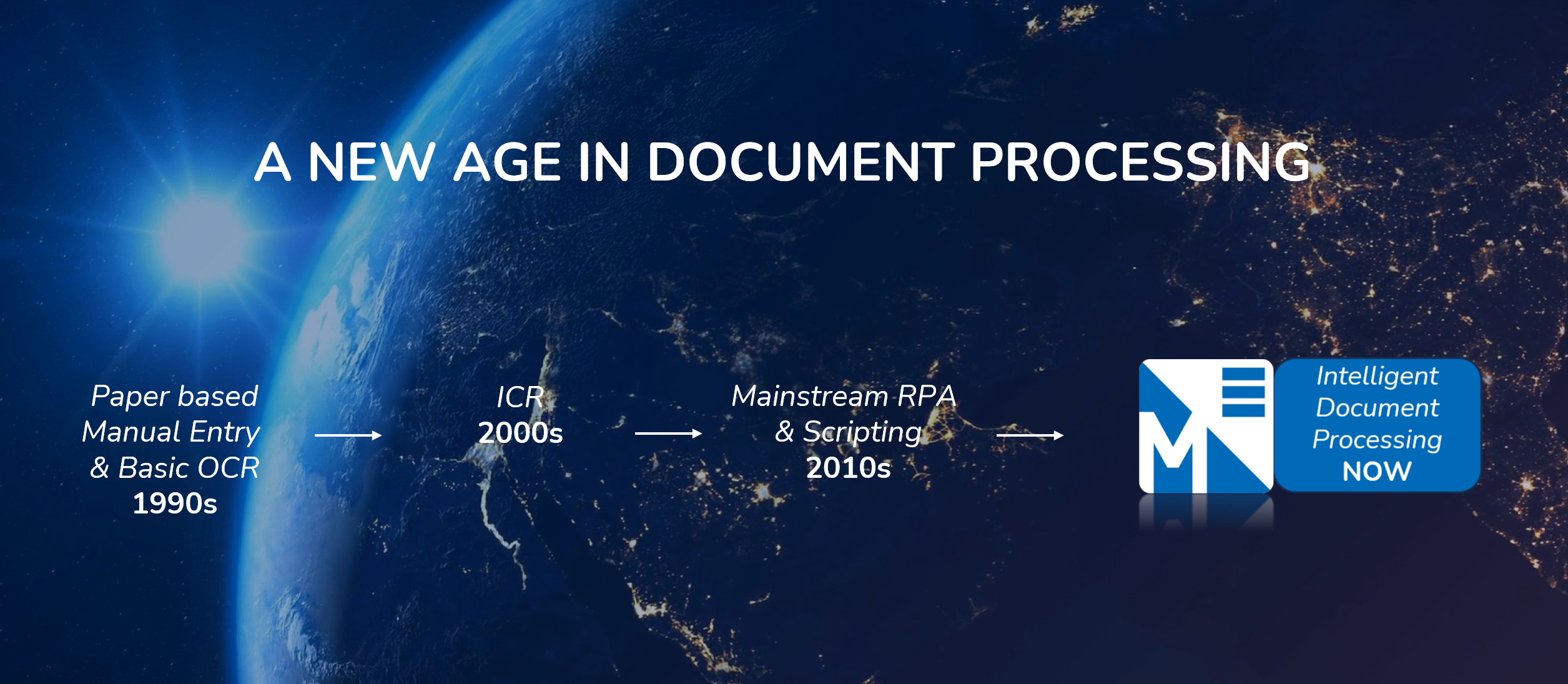
In the 1990’s there were no real electronic documents yet, pages needed to be converted with Optical Character Recognition (OCR) and still required a lot of manual data entry. Paper pages had to be scanned and converted using basic OCR and even then, the results demanded some manual correction.
OCR could capture text, but the technology was not precise: poor scan quality, unusual fonts or even slight skew would be difficult for traditional OCR.
Employees would still spent their time manually correcting what the technology couldn't read.
The 2000s brought Intelligent Character Recognition (ICR), which was far more developed and is able to recognize handprint.
We stress the word PRINT here since people needed to write like a printer for the system to recognize it. This means for example writing in all capitals, respecting the boundaries of a dedicated box to write in and forget about cursive handwriting. As you can see, there were quite some limitations.
The technology improved over the years and was and still is amazing, but it never escaped its dependence on structured input.
Robotic Process Automation (RPA) arrived in the 2010s and added a layer of automation.
But beneath the automation, the extraction layer hadn't changed. OCR and ICR remained the same technology that we still use it to this day.
Today, Intelligent Document Processing (IDP) has revolutionized the market. It makes use of next level extraction engines with a way better precision than traditional OCR and ICR. No more need to tell the engine what to expect. It is capable to read from imperfect images and recognizes all font types, handwriting and a wide range of languages without any configuration or pre-processing. On top, AI analyzes the extracted content and returns data.
That distinction between recognition and interpretation is where AI document technology changes everything.
The AI layer analyzes the content structurally It is able to understand what type of document it is, what the key fields mean and is able to return structured metadata.
IDP doesn't just recognize characters, it interprets context.
It can classify a document based on what the data says, the same way a human would.
Our mission is simple: to intelligently process all kinds of documents into structured information with the power of AI document technology for optimal accuracy.
Lots of companies use AI as a buzzword, we don't. We have done extensive research to find the best match of AI document technology to accompany our IDP solution, MetaServer. Artificial Intelligence plays an important role in our automation solution, but only where it truly adds value. Have a look at some of our demos to witness the unsurpassed power of AI doing some remarkable stuff.
Our solution is designed to use AI selectively and purposefully throughout the entire process.
OCR read shapes. ICR reads handprinted data. RPA adds a layer of automation. IDP interprets context through a single, configuration-free engine.
The documents your business processes every day can now be handled with the same understanding as a human being.
The new age in document processing isn't coming. It's here!
Let's talk about what that means for your operations.