Blog > Meet Radoslav Radev, our Software Engineer
Meet Radoslav Radev, our Software Engineer

Some people learn how things work by reading the manual. But, be it a car or software, Rado prefers to dissect and deep-dive into the inner workings of everything.
Rado's natural curiosity has shaped his career at CaptureBites. He joined CaptureBites in 2023 and helps build new features for MetaServer that make document processing even more effortless and he is the lead programmer of the future MetaServer Web Client and Access Control Manager.
Rado started programming at around age 14 and by 16 he was freelancing and building websites for clients. It didn't take long before websites turned into full applications and applications turned into distributed systems that he built from start to end: the frontend, the backend behind it, the infrastructure it runs on and the deployment that gets it there.
"That is still the part I enjoy most, owning the whole picture instead of one layer of it."
Originally from Bulgaria, Rado moved to the Netherlands for the education and the opportunities, and graduated in Software Engineering. His graduation project was a low-latency Android audio driver for the Bosch communications division, an experience that taught him just how much detail hides underneath something so "simple".
CaptureBites entered the picture during his studies through an internship. He liked the product and the people, and he stayed.
On paper, Rado is a Software Engineer in Web Technologies. In practice his role is broader. He leads the development of the MetaServer Web Client, where users can upload documents to MetaServer, validate document data, and Organize documents through a browser instead of a thick client. On top of that, he also leads the development of the MetaServer Access Control Manager.
He also designs the CI/CD, so everything that turns code into a tested, signed and shipped release runs through pipelines he has built and maintains.
Occasionally he also works on export connectors for MetaServer and Tungsten Express.
When you ask Rado what people outside the company don't realize, then his answer is the invisible part of the job.
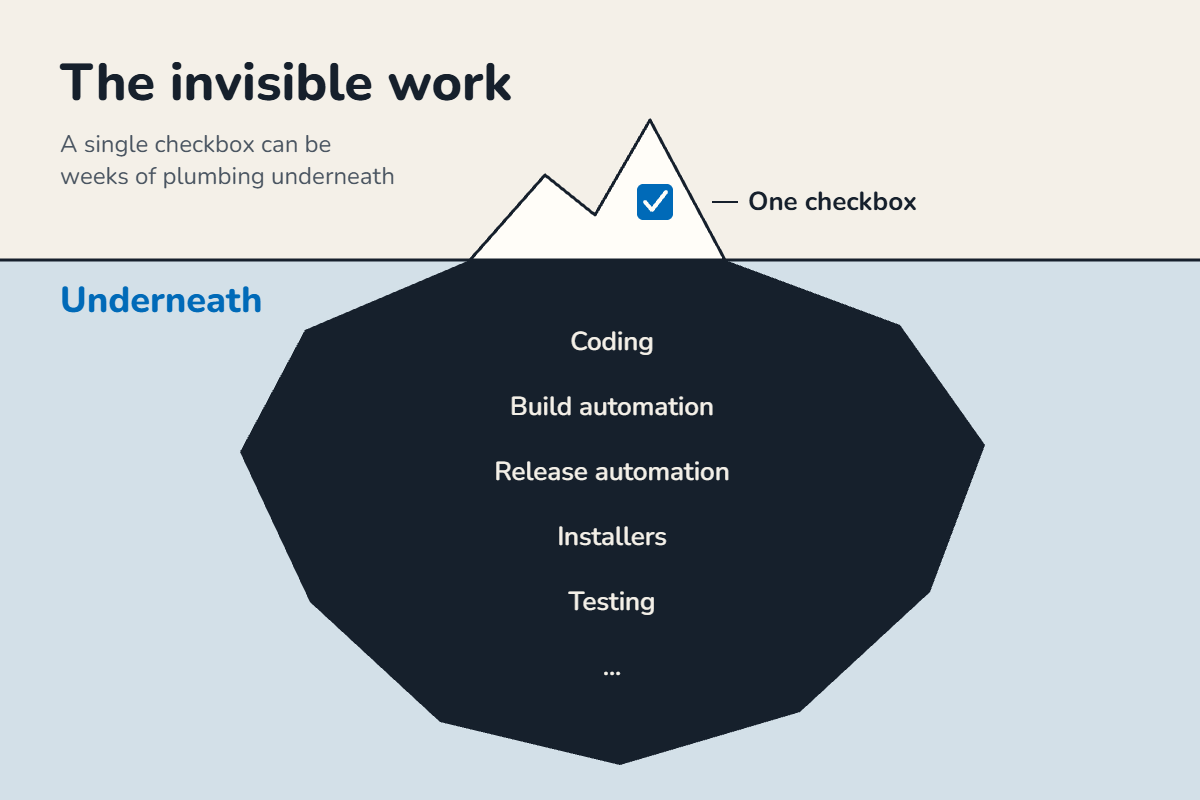
"A single checkbox in the interface can be weeks of plumbing underneath.
A big part of the work is making sure that things customers configured years ago keep working after every update. Then there is everything around the code: build and release automation, testing, installers."
"None of the invisible back-end work shows up in a screenshot, but it is exactly what makes the product feel simple in the best possible way."
Rado is candid about what makes creating software difficult. "Honestly, it's not the coding," he says.
"The real challenge is that the software runs on machines the team cannot see. Every environment is different, from Windows versions and permissions to network policies and other software on the same machine. Reproducing a problem is often much harder than fixing it. Once it can be reproduced, the actual fix can take ten minutes.
The second challenge is versatility. In a single day he can move between a browser, a backend service, a pipeline and a customer's infrastructure, switching context without losing the thread."
"MetaServer stands out because it is built by people who really understand document capture, and it shows in the details.
Instead of solving one step, it automates the entire flow. You configure it rather than program it, so a solution can be shaped around one customer's process instead of forcing the customer into ours.
The other difference is speed. With a team this size, a sensible customer request can be in a build within days instead of sitting on a roadmap for next year."
"If I have a question, I ask the person who knows and get an answer the same day," he says.
"Process is not just done for the sake of process. There is also a lot of trust, and everyone genuinely knows the domain.
That combination is rarer than people think."