
Blog > Why Human-in-the-Loop matters in AI Document Processing
Why Human-in-the-Loop matters in Document Processing using AI

The honest answer is that full automation without oversight is a liability, not a feature. The organizations getting real value from intelligent document processing aren't the ones that remove people from the process. It's the organizations that integrate people in exactly the right place of the process.
Every document processing system will occasionally hit a page that's blurry, a field that's ambiguous or a value that falls outside what the model has seen before. What happens next is the real test of an IDP platform.
Without human oversight, one of two things happens:
1) The autonymous system silently guesses and moves on.
2) The system fails and the whole batch is stalled.
Neither is acceptable. With the right design, a third option exists: the system recognizes and signals what it doesn't know and hands that specific case to a person, while everything else keeps moving.
With the Validate action, you can define validation rules for each of your fields to verify, correct or complete your document’s metadata. If the data doesn’t pass the validation rules, the document shows up in the Validation tab.
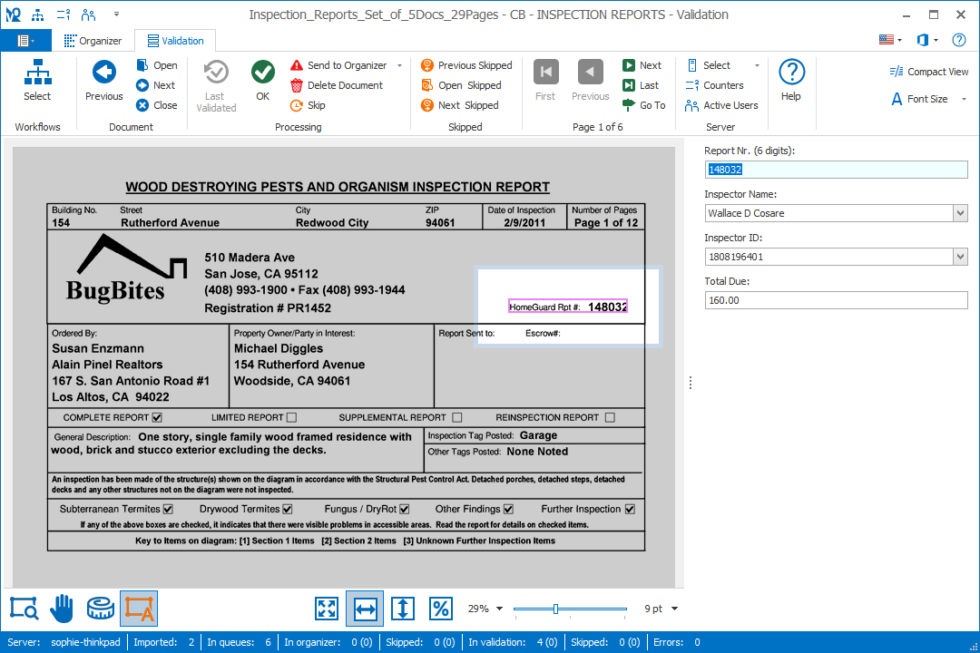
A few examples of how it works:
Confidence-based routing
Every extracted value carries a confidence score. Using rules, you can set the condition that only values below a chosen confidence threshold are flagged for review, while everything above it passes straight through. High-confidence data never touches a human; low-confidence data always does.
Conditional logic
Review requirements can depend on the document itself. A field only needs checking if a status is set to a certain value or if an amount exceeds a defined limit. This keeps reviewers focused on the cases that actually carry risk, instead of re-checking everything.
"Always Check" fields
For exceptionally critical data, you have the option to force a manual check every time, regardless of confidence or conditions. You decide what's critical, not the AI model.
Database validation with fuzzy matching
When a value needs to match an existing database record, (e.g. a supplier name, an inspector ID, a product code, etc.) MetaServer can look it up automatically. If there's an exact match, it's automatically used.
For non-exact matches, you have the option to use "fuzzy lookup". If the match is close enough and complies with the specified, minimum confidence level (e.g 95% (= default)) you can decide whether it's accepted automatically or sent to validation to be confirmed by a person.
Double-entry for high-stakes fields
For values where a single mistake is costly, two operators can enter the value independently. If they disagree, the system forces a resolution step rather than silently picking one.
Reject workflows
If a document simply can't be processed, whether it's because of poor scan quality, missing information or just plainly the wrong document, it can be rejected into a defined follow-up action instead of being forced to proceed further down the workflow. This prevents the other 95% of normal documents getting slowed down.
It concentrates human attention exactly where it adds value, and lets the system prove, field by field, why it made the decision it did.
Regulatory expectations are catching up with automation. The EU AI Act now requires human oversight and retained audit logs for high-risk AI document processing use cases. That means "we automated it" is no longer a sufficient answer for a compliance audit. "We automated it, and here's exactly which decisions a human verified and why" is.
This isn't just a legal checkbox. It's also what makes automation trustworthy enough to actually rely on. A system that flags its own uncertainty is one your team can trust with the documents that matter.